 Hamid Motahari
Works / Clock
Heriz Interval
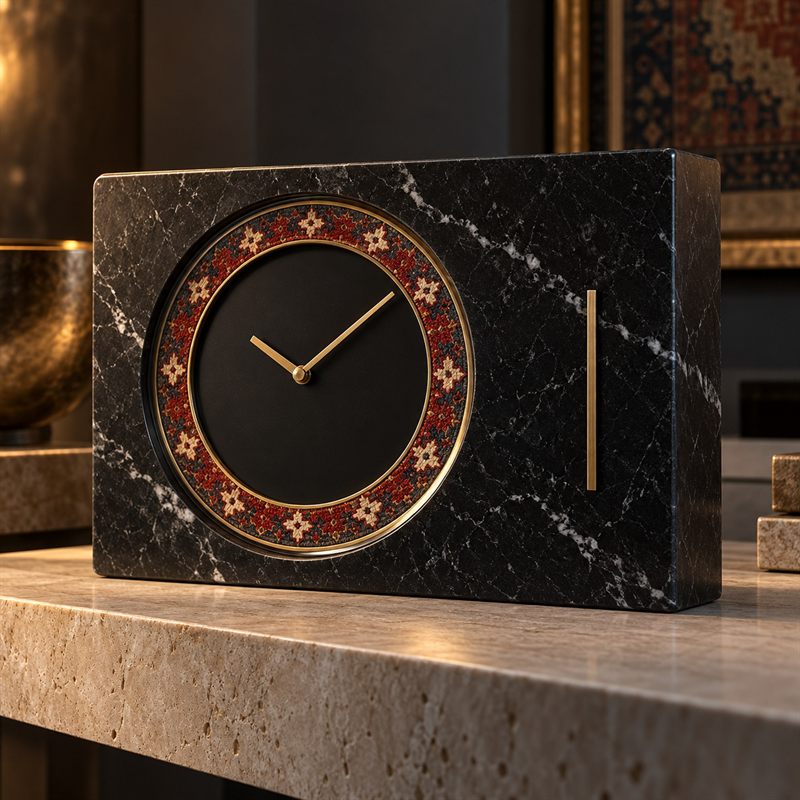
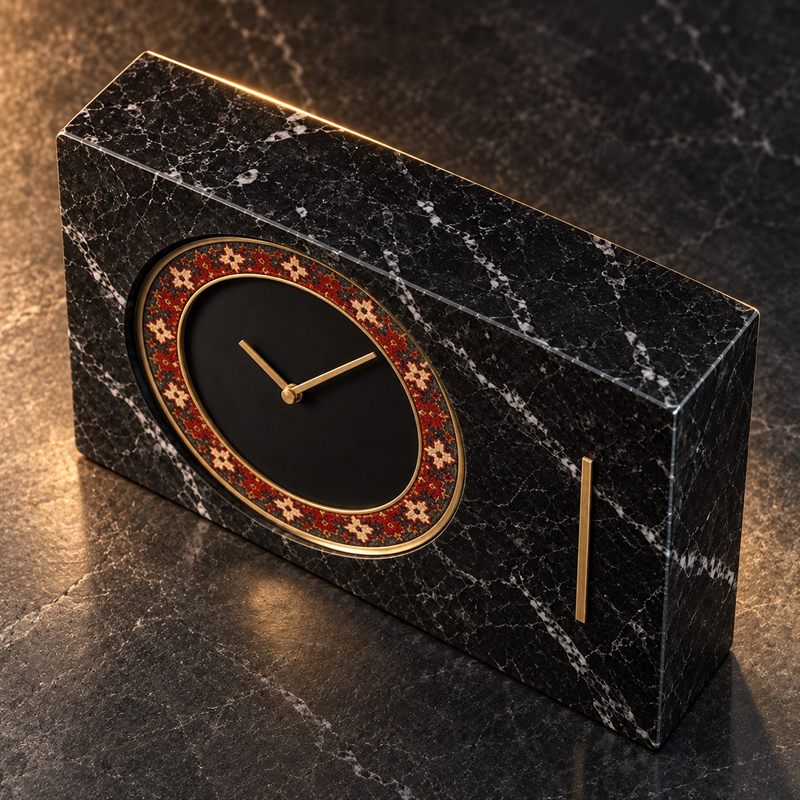
Heriz Interval places a textile measure of time inside a monolithic contemporary body. The clock is a 320 by 220 by 60 millimetre block of black Marquina marble. Its 150 millimetre circular aperture is shifted 35 millimetres left of centre, leaving a quiet field of stone on the right. That field is interrupted only by one 90 millimetre vertical brass inlay. The line has no numerical function; it acts as a spatial counterweight and a precise modern equivalent of a carpet's boundary. The dial is matte black and contains no numerals, hour marks or second hand. Two straight brass hands form the only moving graphic.
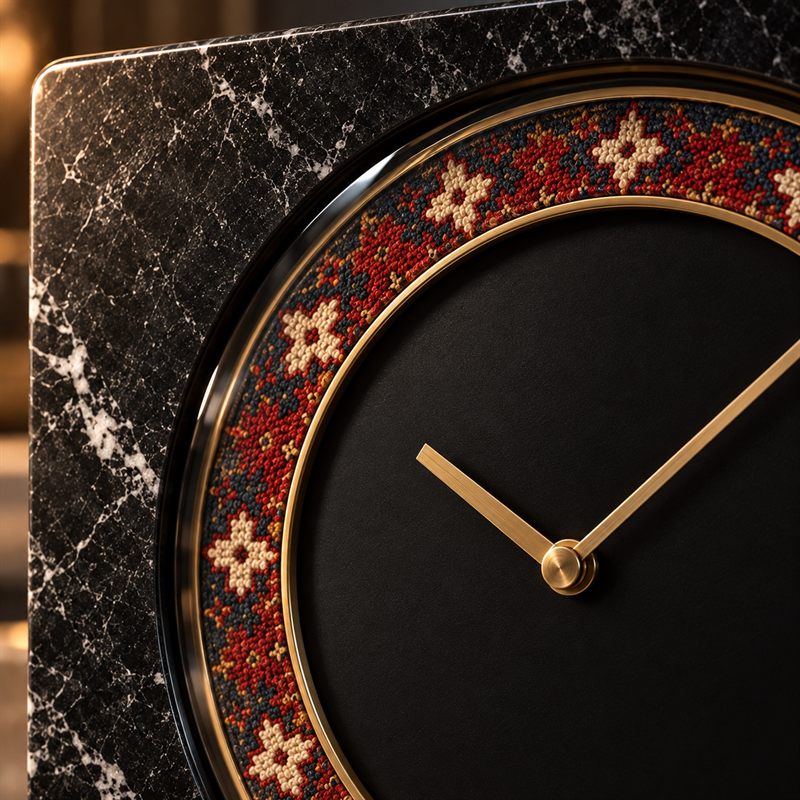
Around them, beneath smoked sapphire crystal, an 18 millimetre annulus holds a miniature hand-knotted Heriz-derived pattern in madder, indigo and ivory. The carpet is not reproduced across the face. It occupies one controlled ring, converting repeated knots into a circular interval while preserving the physical depth of fibre. External light is essential to the encounter. A warm grazing beam passes through the crystal and reveals the annulus knot by knot; a narrow highlight travels along the brass hands and right-hand inlay; soft ambient light exposes the marble's white mineral veins. In lower light the pattern recedes and the clock returns to a nearly abstract black rectangle.
The object is conceived for a numbered edition produced by stone, horology and textile specialists. The marble body is CNC cut and hand polished, with a removable rear service plate for the silent quartz movement. The woven ring is mounted on an inert annular carrier beneath replaceable sapphire. The movement, hands and crystal can be serviced independently, while the offset geometry and minimal components keep the clock physically credible and suitable for long-term domestic use.
- Type
- Clock
- Materials
- Black Marquina marble, brass, smoked sapphire crystal, hand-knotted textile
- Edition
- Numbered edition
- Design
- Hamid Motahari